
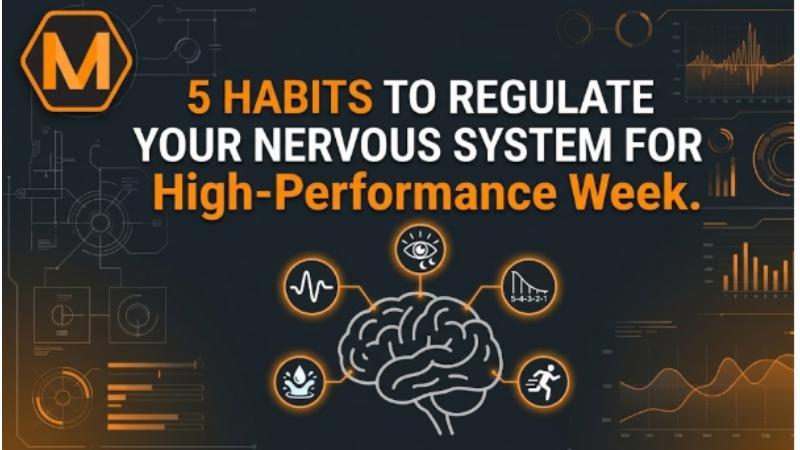
In the modern professional and academic landscape, “high performance” is often incorrectly equated with constant hustle. However, true peak performance isn’t about how much caffeine you can consume or how many hours you can stay awake; it is about the state of your nervous system. When your body is stuck in a state of “fight or flight”—characterized by high cortisol and shallow breathing—your brain’s prefrontal cortex, the area responsible for logic and creativity, effectively shuts down. To achieve a week of genuine productivity, you must learn to shift your body from the sympathetic (stress) branch of the nervous system to the parasympathetic (rest and digest) branch.
Achieving this balance is especially critical when you are facing high-stakes deadlines or complex research projects. If you find yourself overwhelmed by a massive workload, it is often more productive to delegate specific tasks so you can focus on your physiological health. For instance, many students choose to buy expository essay services from myassignmenthelp to clear their mental slate and reduce the chronic hypervigilance that comes with academic burnout. By strategically managing your external stressors, you create the necessary “biological bandwidth” to implement the following five habits for a regulated and high-performing nervous system.
The Science of the Autonomic Nervous System (ANS)
To understand why these habits work, we must look at the “Autonomic Ladder.” Your nervous system is constantly scanning the environment for cues of safety or danger. When you feel safe, you are at the top of the ladder in the Ventral Vagal state. This is where “Flow State” happens. As stress increases, you drop into Sympathetic Activation (anxiety/frustration). If stress remains chronic, you fall into Dorsal Vagal Shutdown (burnout/depersonalization).
1. Master the “Vagal Brake” with Physiological Sighs
The vagus nerve is the superhighway of your nervous system, connecting your brain to nearly every major organ. When you are stressed, your vagal tone drops, leaving you feeling edgy and reactive. One of the fastest ways to “apply the brake” to a racing heart is the physiological sigh. This is a breathing pattern discovered by neurobiologists to be the quickest way to offload carbon dioxide and lower your heart rate in real-time.
To perform this, take a deep breath in through your nose, followed by a second, shorter “sip” of air at the very top to fully inflate the alveoli in your lungs. Then, release a very long, slow exhale through your mouth. Doing this just three times can instantly signal to your brain that you are safe. For high performers, practicing this during transitions—such as between meetings or before starting a difficult study session—ensures that you aren’t carrying the stress of the previous hour into the next task.
2. Implement “Digital Sunlight” and Circadian Alignment
Your nervous system is deeply tied to the movement of the sun. In 2026, we spend an average of 90% of our time indoors under artificial “blue light,” which confuses our internal clock and keeps our cortisol levels high long into the evening. This disruption leads to poor sleep quality, which is the fastest way to deregulate your nervous system.
To fix this, view natural sunlight within 30 minutes of waking up. This triggers a timed release of cortisol in the morning (when you want it) and sets a timer for melatonin production in the evening. Additionally, practicing “Digital Minimalism” after 8:00 PM allows your brain to enter a state of safety. If you are staying up late staring at a screen because you are worried about a deadline, you are effectively telling your body it is under attack. In these moments, it is often better for your long-term health to hire an expert to write my essay for money so you can prioritize your circadian rhythm and wake up refreshed. myassignmenthelp provides the professional support needed to keep your schedule human-centric rather than screen-centric.
3. Somatic Grounding and the 5-4-3-2-1 Technique
When we are anxious about the future or ruminating on the past, we “leave” our bodies. This mental displacement keeps the nervous system in a state of high alert because it loses its connection to the physical environment. Somatic grounding is the practice of pulling your awareness back into the present moment through your senses.
The 5-4-3-2-1 technique is a favorite among high-performing executives and students alike. It involves identifying:
- 5 things you can see (the texture of the wall, the color of your pen).
- 4 things you can touch (the weight of your feet on the floor, your clothes).
- 3 things you can hear (the hum of the AC, distant traffic).
- 2 things you can smell.
- 1 thing you can taste.
4. Strategic Cold Exposure for Resilience
While it sounds counterintuitive, exposing your body to short bursts of “good stress” (hormetic stress) can actually make your nervous system more resilient to “bad stress” later. Taking a 30-second cold shower or splashing ice water on your face triggers a “diving reflex.” This reflex immediately slows the heart rate and increases the production of norepinephrine and dopamine, which improves focus and mood.
By voluntarily entering a cold environment and staying calm, you are training your nervous system to remain regulated when unexpected challenges arise during your week. It is a form of “gymnastics” for your nerves, ensuring that when a deadline moves up or a project changes direction, you have the internal stability to handle the pivot without a total system meltdown.
5. Movement as a “Stress Completion” Loop
In the animal kingdom, when a prey animal escapes a predator, it will often shake its body to “shake off” the adrenaline. Humans, however, often experience the stress of a bad email or a hard exam and then sit perfectly still at a desk. This traps the stress energy in the body, leading to muscle tension, headaches, and chronic fatigue.
To regulate your system, you must complete the stress response loop through movement. This doesn’t require a two-hour workout. Even five minutes of jumping jacks, dancing, or a brisk walk around the block signals to your body that the “threat” has been outrun and it is now safe to relax. High-performance weeks are built on these small, frequent intervals of movement that prevent stress from accumulating.
The High-Performance Energy Audit
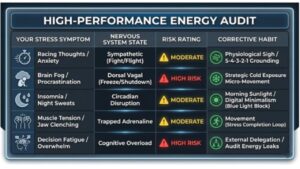
To maintain these habits, you must audit your energy leaks. Use the table below to identify where your nervous system is losing its regulation and which habit can fix it.
| Stress Symptom | Nervous System State | Corrective Habit |
| Racing thoughts / Anxiety | Sympathetic (Fight/Flight) | Physiological Sigh / 5-4-3-2-1 |
| Brain Fog / Procrastination | Dorsal Vagal (Freeze) | Cold Exposure / Micro-Movement |
| Insomnia / Night Sweats | Circadian Disruption | Morning Sunlight / Blue Light Block |
| Muscle Tension / Jaw Clenching | Trapped Adrenaline | Stress Completion Loop (Movement) |
| Decision Fatigue | Cognitive Overload | External Delegation via myassignmenthelp |
Deep Work vs. Shallow Work: The Nervous System Edge
The ability to perform “Deep Work”—a term coined by Cal Newport—is directly tied to your ability to remain in a Ventral Vagal state. In this state, your brain can access complex problem-solving abilities and creative synthesis. However, most students and professionals operate in a state of “shallow work,” constantly interrupted by notifications and low-level anxiety.
By implementing the habits above, you are not just “relaxing”; you are optimizing your biological hardware for high-level output. When your nervous system feels safe, your vocabulary expands, your ability to structure arguments improves, and the time it takes to complete a task drops significantly. This is why a regulated student can often finish a 2,000-word paper in four hours, while a dysregulated student may struggle for twelve.
Integration Strategy: The “Sunday Reset”
To ensure a high-performance week, use your Sunday to set the “safety baseline” for your nervous system.
- Clear the Backlog: Review your upcoming deadlines. If the list is physically causing your heart to race, use myassignmenthelp to offload the most tedious tasks.
- Meal Prep for Dopamine: Prepare foods rich in Tyrosine (like almonds or eggs) to support your focus neurotransmitters.
- Environment Sweep: Remove visual clutter from your workspace. A cluttered desk sends subtle “danger” cues to the brain.
Final Thoughts for the Global Student
Whether you are a student in London or a researcher in Tokyo, the human nervous system remains the same. It requires safety, rhythm, and periods of recovery to function at its highest level. In a world that demands 24/7 availability, choosing to regulate your body is a radical and highly effective act of productivity.
Don’t let your “fight or flight” response dictate the quality of your work. Take control of your biology, use the expert support tools available to you, and watch your performance transform. By protecting your peace, you are actually protecting your potential.
Frequently Asked Questions
What is nervous system regulation?
It is the process of shifting your body from a state of stress and high alert back to a state of calm and balance. By using specific breathing and sensory techniques, you can manually signal to your brain that it is safe to focus and rest.
How quickly can I reset my stress levels?
While long-term resilience takes time to build, immediate tools like the physiological sigh or cold water exposure can lower your heart rate and reduce physical tension in as little as 30 to 60 seconds.
Why does sunlight affect my productivity?
Natural light exposure early in the day regulates your internal circadian clock. This balances your cortisol levels for morning energy and ensures your body produces enough melatonin at night for restorative sleep.
What is the “stress completion loop”?
When you experience a stressful event, your body produces adrenaline that needs a physical outlet. Completing the loop through movement—like a brief walk or stretching—tells your body the “threat” is gone, preventing chronic physical tension.
About The Author
Oliver Smith is a dedicated content researcher and academic strategist at myassignmenthelp. He specializes in bridging the gap between complex theoretical concepts and practical, high-performance applications for the modern student.